Best AI humanizer: November 2026 benchmark results
Phrasly Ultra ranked first overall in our November 2026 AI humanizer benchmark. StealthGPT Super was second, while Grammarly Pro had the highest writing-quality score. We tested 15 services on the same 50 inputs to compare detector bypass and the quality of the resulting text.
Built by the StealthGPT team. StealthGPT participates in this benchmark; this is not an independent third-party endorsement.
Which AI humanizer performed best in November 2026?
Phrasly Ultra had the highest overall score, 87.60/100, and the highest weighted detector bypass, 94.80%. StealthGPT Super ranked second overall at 70.34/100. These rankings describe this sample and the recorded settings, rather than every possible use of each service.
The overall score gives detector bypass a 70% weight and writing quality a 30% weight. A separate quality leaderboard helps readers who put more emphasis on preserving the source and producing readable text.
AI humanizer comparison: overall, bypass and quality
| Overall rank | Humanizer | Overall average | Overall median | Weighted bypass | Quality | |
|---|---|---|---|---|---|---|
| 1 | Phrasly Ultra | 87.60 | 91.30 | 94.80% | 70.80 | 0.93 |
| 2 | StealthGPT Super | 70.34 | 74.05 | 69.00% | 73.48 | 1.08 |
| 3 | WriteHuman | 56.21 | 68.15 | 60.00% | 47.38 | 1.04 |
| 4 | Rephrasy | 37.49 | 26.95 | 27.60% | 60.56 | 1.11 |
| 5 | Undetectable.ai | 32.72 | 24.45 | 23.70% | 53.76 | 1.22 |
| 6 | Clever Humanizer | 31.80 | 28.40 | 14.60% | 71.94 | 1.00 |
| 7 | ZeroGPT Humanizer | 30.76 | 24.55 | 20.40% | 54.94 | 1.21 |
| 8 | BypassGPT | 28.71 | 28.25 | 9.40% | 73.78 | 1.42 |
| 9 | Grubby | 28.36 | 26.85 | 10.40% | 70.28 | 1.19 |
| 10 | Grammarly Pro | 27.60 | 28.10 | 3.70% | 83.38 | 1.23 |
| 11 | Humbot | 27.56 | 25.55 | 9.90% | 68.78 | 1.41 |
| 12 | Solvely | 25.97 | 25.70 | 6.10% | 72.32 | 1.15 |
| 13 | RewriteAI | 22.98 | 22.10 | 5.50% | 63.78 | 1.22 |
| 14 | QuillBot | 22.79 | 23.20 | 1.50% | 72.46 | 1.04 |
| 15 | HIX Bypass | 16.62 | 16.40 | 4.60% | 44.66 | 1.15 |
All 15 services received the same 50 frozen inputs. Length ratio is the average output-to-input word ratio and is diagnostic only; it does not affect scores.
Phrasly Ultra vs StealthGPT Super: what did we find?
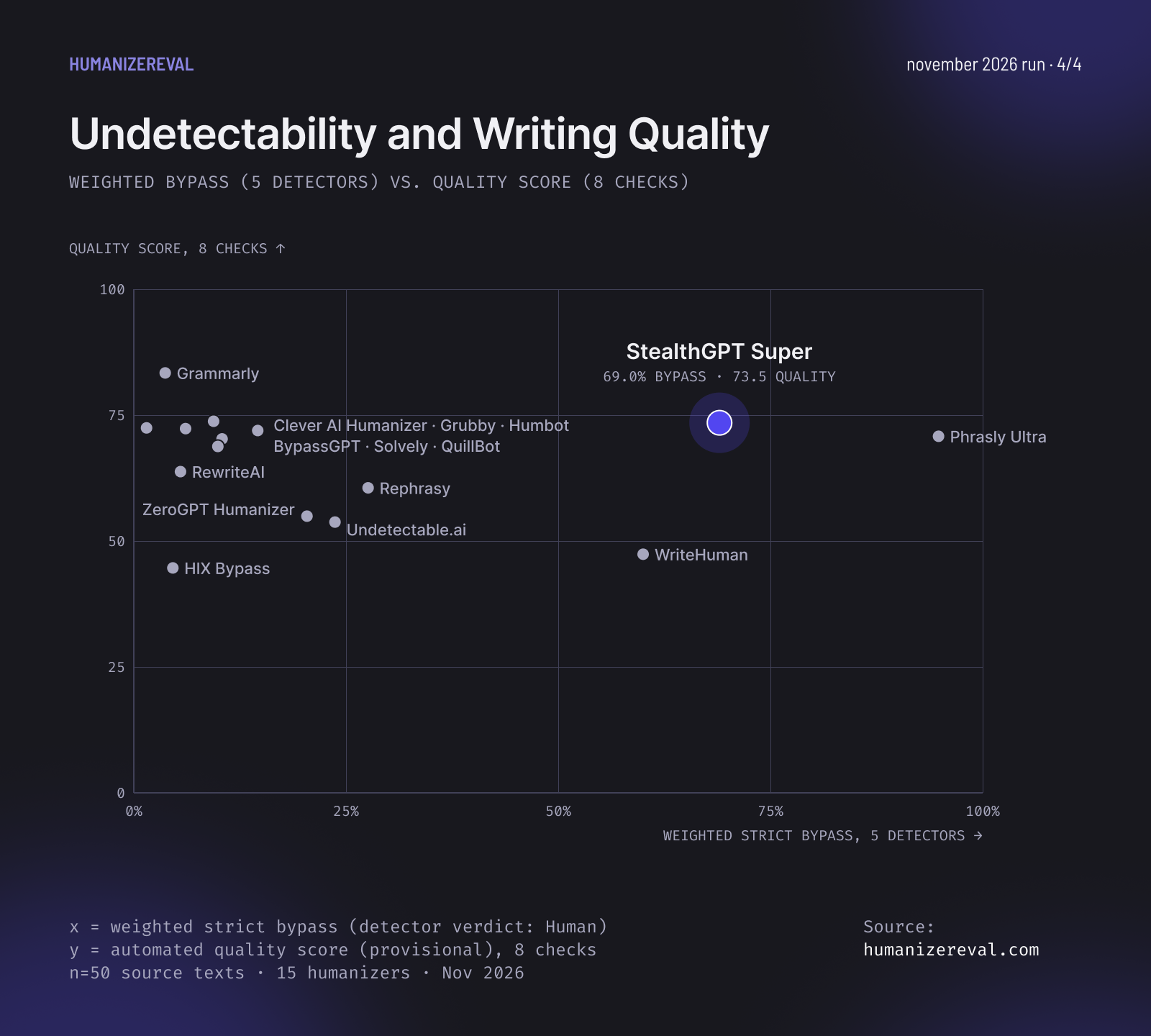
Phrasly Ultra achieved 94.80% weighted bypass with 70.80 quality. StealthGPT Super achieved 69.00% weighted bypass with 73.48 quality. Phrasly led bypass by 25.80 percentage points; StealthGPT led quality by 2.68 points. Under this edition’s 70/30 formula, the bypass advantage put Phrasly first overall.
For individual detector pass counts and the same-input comparison, see Phrasly Ultra vs StealthGPT Super. A difference in average quality is not, by itself, evidence that every output from one tool is better.
Which AI humanizer had the best writing quality?
Grammarly Pro led the quality composite at 83.38/100, with 3.70% weighted bypass. High writing quality and high detector bypass are different outcomes, which is why we report both rather than describing a quality winner as the best bypass tool.
Quality covers readability, meaning preservation, structure, factual consistency, completeness, grammar, hallucinations and stance preservation. Compare all eight writing-quality metrics and their weights. Definitions and aggregate scores are public; proprietary evaluation instructions and implementation details remain private.
Does better AI-detector bypass mean lower writing quality?
There are tradeoffs between particular services, but this run does not show a strong universal inverse relationship. Across the 15 service averages, the descriptive bypass/quality correlation is about −0.09. StealthGPT combines relatively strong bypass with quality above Phrasly in this run; that does not establish it as the only exception to a general rule.
How was the AI humanizer benchmark run?
We generated 50 English source texts once, froze their content and identifiers, and sent the identical inputs to all 15 humanizers. The sources span five model families, with ten texts per family. Eleven services were collected through APIs; Grammarly Pro, QuillBot, Solvely and Clever Humanizer were collected through their web interfaces.
The resulting 750 outputs each received five detector results and a quality assessment against the source. Humanizer settings and collection methods are recorded on the individual service pages. Phrasly used Ultra Max; the Grammarly set uses Pro Humanizer rewrites. The frozen inputs and generation prompts and full public methodology explain the scope of the comparison.
Which AI detectors were used?
The humanization composite weights Pangram 40%, GPTZero 30%, Originality.ai 5.0 20%, Winston AI 5%, ZeroGPT 5%. Mixed and uncertain outcomes do not count as strict-human passes. The detector pages explain each vendor’s score meaning and the benchmark’s pass mapping.
What are the limits of these results?
The detector and overall weights were revised after results were visible; they were not preregistered or calibrated to a shared false-positive rate. Detector bypass on humanized text is not detector accuracy on verified human writing. This edition did not run a new unchanged-AI detector baseline.
Quality scores are automated and provisional. Of the 750 outputs, 602 retain evidence-review flags; a flag is not a confirmed defect. No independent human adjudication is claimed. Results can change with new inputs, modes or detector versions, and the November scores are not directly comparable with earlier editions.
Download the November 2026 benchmark data
The score export provides 750 per-output measurements, detector classifications and frozen text hashes. The input export includes the 50 source texts and their generation prompts. Use the published weights to verify the composite arithmetic; the underlying proprietary quality assessments cannot be independently rerun from these downloads alone.
Per-output scores CSV · Frozen inputs and prompts CSV · Scoring manifest · Verification bundle · GitHub report · Earlier editions
Verify the results without publishing humanized text
Following the earlier GitHub editions, the public report includes source texts, anonymized scores and summaries, while humanizer output text stays private. November also includes 750 source/output hash commitments and 15 per-humanizer result files. The saved outputs and all five detector tables were privately cross-checked before this release.
The public verifier checks the released file hashes, 50 frozen inputs, all 750 humanizer/sample pairs and every published score aggregate. Hash commitments establish consistency with retained evidence; they are not vendor-signed proof of origin or independent validation of the private quality judgments.
- GitHub report and per-humanizer results · snapshot
e96593a5 - Download the public verification bundle
- 750 output commitments CSV · File-integrity manifest · Sanitized provenance
- Read the standalone verifier · Python standard library only, no API keys or paid calls needed
After downloading the bundle:
unzip verification-bundle.zip
cd humanizereval-november-2026
python3 scripts/verify_november_report.py reports/2026-11-17-humanizer-comparison
Humanized output bodies, credentials, raw vendor responses and production quality instructions are excluded from this bundle.
Review October 2026 results and September 2026 results under their original methods. For the current live table, see the AI humanizer leaderboard.
Frequently asked questions
Can an AI humanizer guarantee bypass of every detector?
A benchmark pass is an observation on a particular text, detector version and configuration. This run cannot establish a universal guarantee for new text or future detector versions. Compare the individual detector results as well as the weighted average.
Can the November 2026 scores be compared directly with October?
November uses five detectors, revised strict pass rules, eight weighted quality dimensions and a 70/30 overall composite. October used a different panel and scoring system. Compare tools within the same edition; earlier editions remain archived.
Why was Ryne excluded from the November benchmark?
Ryne was removed after weak prior detector-bypass performance and an operator-reported preliminary observation that its latest model remained detectable. The methodology distinguishes this observation from the published historical pass counts. Ryne has no scored November submission.